
Understanding Canada's National Building Code and Provincial Variations
By draftGecko
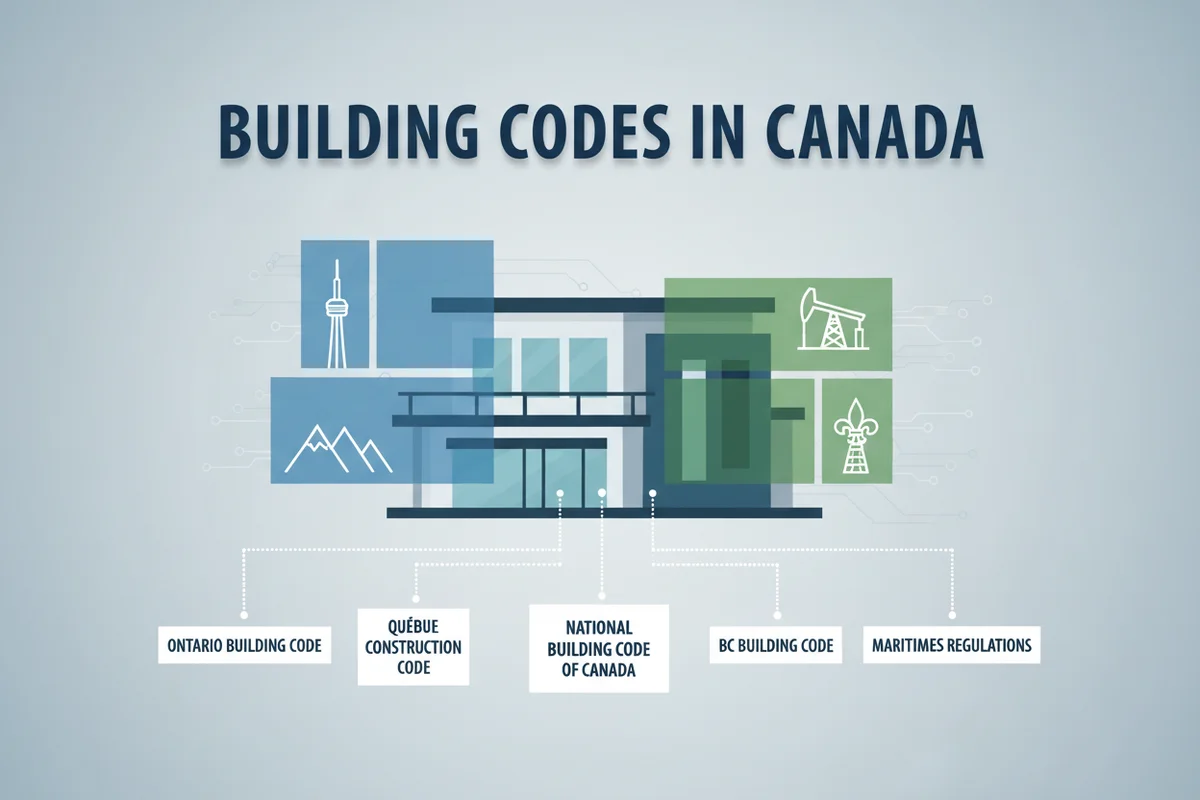
Explore Canada's National Building Code and how provincial variations impact construction practices, safety, and compliance across the country.
Understanding Canada's National Building Code and Provincial Variations
Building codes are the foundation of safe, healthy, and sustainable construction. In Canada, the regulatory framework governing how buildings are designed, constructed, altered, and demolished is shaped by a combination of national guidance and provincial authority. For builders, architects, and construction managers working across the country, understanding how the National Building Code of Canada (NBC) operates alongside provincial and territorial variations is essential to delivering compliant projects efficiently.
The National Building Code of Canada: Purpose and Scope
The NBC is a model code developed by the Canadian Board for Harmonized Construction Codes and published by the National Research Council of Canada (NRC). It establishes technical requirements for the design and construction of new buildings, as well as the alteration, change of use, and demolition of existing structures. The code addresses a broad range of concerns including occupant safety, public health, accessibility, fire protection, structural integrity, and energy efficiency.
It is important to understand that the NBC is a model code rather than law in itself. Federal jurisdiction over building regulation in Canada is limited, and it is the provincial and territorial governments that hold the constitutional authority to enact legislation governing building design and construction within their borders. The NBC provides a consistent technical baseline that provinces can adopt directly, modify to reflect local conditions, or use as a reference when developing their own legislation.
Building construction is a significant part of Canada's economy, employing nearly 1.4 million Canadians, which underscores why a coherent and well-understood regulatory framework matters enormously to the industry.
What the NBC 2025 Edition Introduces
The most recent edition of the NBC, published in 2025, includes several notable updates that reflect evolving priorities in the construction sector. Accessibility objectives have been expanded to apply to all types of dwelling units, not just those previously covered. The 2025 edition also introduces requirements for passive vertical radon stacks, which are ventilation pathways designed to reduce radon gas accumulation in buildings. Projected climatic data anticipating weather and environmental trends over the next 50 years has been incorporated to help designers account for long-term climate change in structural and envelope decisions. Additionally, the environment objective has been expanded to address greenhouse gas emissions, signalling a clear shift toward low-carbon construction practices.
How Provinces and Territories Adapt the NBC
Because each province and territory has its own legislative authority, the way the NBC is adopted and applied varies considerably across Canada. Some jurisdictions adopt the NBC without modification, while others make substantial amendments to suit regional climate, geography, or policy priorities.
Prince Edward Island, Nova Scotia, and Newfoundland and Labrador have legislation that enforces the current version of the NBC directly, meaning builders in those provinces are working to the same technical requirements as the national model.
Manitoba, New Brunswick, and Saskatchewan have adopted the 2010 edition of the NBC as regulations under their respective provincial acts. This means builders in those provinces may be working to requirements that predate the 2020 and 2025 updates, which is a practical consideration when specifying materials or systems that reference newer standards.
Alberta adopts the NBC with modifications to reflect local needs, including considerations related to its climate and energy sector context.
British Columbia develops its own building code based on the NBC but includes specific variations that address seismic risk, energy performance targets, and other regional factors. The BC Building Code is a well-developed standalone document that professionals working in that province must consult directly.
Ontario administers its own Building Code, which is grounded in the NBC but includes province-specific requirements. Ontario's code is enforced through the Building Code Act and is administered at the municipal level by chief building officials.
Quebec adopts the NBC with amendments and includes additional provisions specifically addressing existing buildings, reflecting the province's significant stock of older construction.
This patchwork of adoption means that a builder operating across multiple provinces must maintain familiarity with several different regulatory documents simultaneously, which adds administrative complexity to multi-jurisdictional projects.
Where to Access the Codes
The NBC and its associated user's guides are available in electronic format free of charge through the NRC Publications Archive. Printed copies can be purchased through the NRC Virtual Store for those who prefer physical reference documents on site or in the office.
For provincial codes, each province maintains its own publication and distribution channels. British Columbia's building code is available through the provincial government's website, Ontario's Building Code is accessible through the Ministry of Municipal Affairs and Housing, and similar resources exist for other provinces. Given that codes are updated periodically and provinces adopt new editions on their own schedules, it is always advisable to confirm with the relevant local authority having jurisdiction (AHJ) that you are referencing the current applicable version before beginning design or construction documentation.
The Development Approval Process
Obtaining development approval in Canada is a multi-stage process that generally involves submitting detailed drawings and documentation to the local municipality or regional authority, undergoing a compliance review against the applicable building code and zoning bylaws, and receiving the necessary permits before construction can begin.
The specific steps vary by province and municipality. In most jurisdictions, the process begins with a zoning or land use review to confirm that the proposed development is permitted on the subject site. This is followed by a building permit application, which requires submission of construction drawings prepared to the standard required by the local authority. Depending on the project type, additional referrals may be required to fire services, public health, transportation, or environmental agencies.
For larger or more complex projects, a pre-application consultation with the municipality is strongly recommended. Many jurisdictions offer this service to help applicants understand local requirements before investing in full design documentation, which can reduce costly revisions later in the process.
Approval Timelines and What Influences Them
Approval timelines in Canada vary significantly depending on the complexity of the project, the jurisdiction, and the current workload of the local permitting authority. Simple residential projects in smaller municipalities may receive permits within a few weeks, while complex commercial or multi-residential developments in major urban centres can take many months from application to permit issuance.
Factors that commonly influence timelines include the completeness of the application at submission, the need for referrals to other agencies, whether variances or rezoning are required, and the volume of applications being processed by the authority at any given time. Incomplete applications are one of the most common causes of delay, as they trigger requests for additional information that restart review timelines.
Some municipalities have introduced measures to improve efficiency, including concurrent review processes and dedicated fast-track streams for certain project types, but the experience remains inconsistent across the country.
Navigating Harmonization and Regional Differences
The tension between a harmonized national code and regionally adapted provincial codes is a genuine challenge for the industry. A consistent framework reduces compliance costs for builders and manufacturers operating nationally, but provinces have legitimate reasons to tailor requirements to their specific climates, demographics, and policy goals. The 2025 NBC updates around climate data and greenhouse gas emissions reflect an attempt to keep the national model relevant and forward-looking, but provinces will still determine when and how those updates are incorporated into enforceable law.
For builders, architects, and construction managers, the practical implication is clear. Staying current with both the NBC and the specific code in force in each province where you work is not optional. Consulting the local authority having jurisdiction before finalising design decisions remains the most reliable way to ensure compliance and avoid costly corrections during or after construction.