
Building in Canada: Construction Methods, Costs, and Market Trends in 2025
By draftGecko
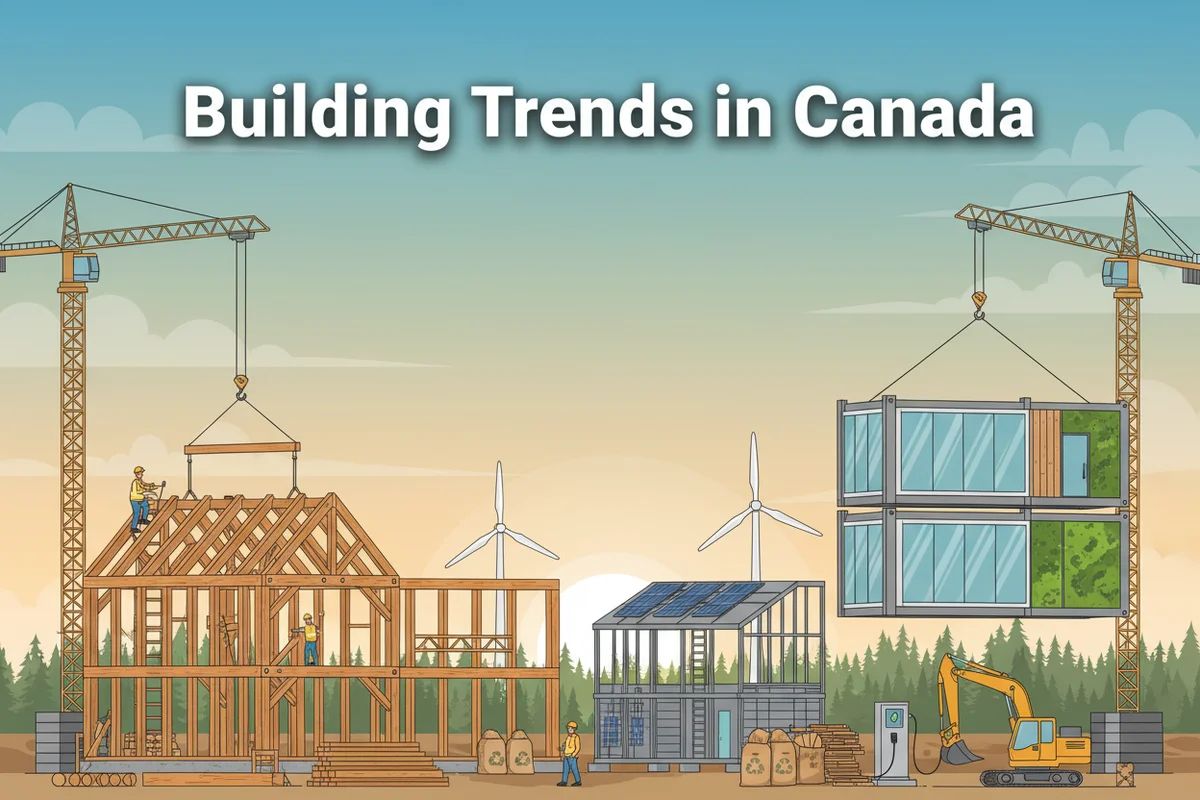
Explore Canada's construction methods, costs, and market trends for 2025. Understand regional differences and sustainable practices shaping the industry.
Building in Canada: Construction Methods, Costs, and Market Trends in 2025
Canada's construction industry stands as one of the most significant contributors to the national economy, employing approximately 1.2 million people as of 2023 and representing around 7% of the total Canadian workforce. For builders, developers, and trades professionals operating in this market, understanding the regional differences in construction methods, cost structures, and regulatory environments is essential for accurate project planning and competitive bidding. The industry is projected to reach a total value of $354.9 billion USD by 2024, growing at a compound annual growth rate (CAGR) of 8.5%, which signals sustained demand across both residential and commercial sectors despite a number of structural challenges that vary considerably from province to province.
Residential Construction Methods and Costs
Residential construction in Canada is dominated by wood-frame building techniques, a method that has remained standard for low-rise and mid-rise housing due to the country's abundant timber supply and the well-established skill base among local trades. In colder provinces such as Alberta, Saskatchewan, and Manitoba, builders typically incorporate enhanced insulation systems and vapour barriers into the building envelope to meet the thermal performance requirements set out under the National Building Code of Canada (NBC). In coastal British Columbia, seismic design considerations add an additional layer of complexity and cost to residential projects, requiring engineered connections and specific foundation systems.
Construction costs across Canadian cities vary substantially depending on land values, labour market conditions, and local material supply chains. Vancouver consistently records the highest average building construction costs in Canada, with figures reaching among the highest per square meter of any city in the country as of 2025. Toronto and Montreal follow, though at notably different price points that reflect the distinct economic conditions in Ontario and Quebec respectively. For residential builds, cost estimates from industry sources suggest that custom homes in major urban centres can range from approximately $1,500 to over $3,000 CAD per square meter depending on specification level, finishes, and site conditions, though these figures fluctuate with exchange rates and input costs.
Commercial Construction Methods and Costs
Commercial construction in Canada encompasses a broad range of building types including office towers, retail centres, industrial warehouses, and mixed-use developments. Steel frame and reinforced concrete construction are the dominant structural systems for mid-rise and high-rise commercial buildings, while tilt-up concrete panels are widely used for industrial and warehouse facilities, particularly in suburban areas of Ontario and Alberta where large footprint buildings are common.
The Altus Canadian Construction Guide, which is widely referenced by quantity surveyors and cost consultants across the industry, provides benchmark cost data that illustrates the significant spread in commercial construction costs between building types and regions. A standard office building in Toronto or Vancouver will carry a substantially higher per-square-meter cost than a comparable structure in a smaller market such as Halifax or Winnipeg, reflecting differences in labour rates, subcontractor availability, and local permitting requirements. For commercial projects, costs in major markets can range from roughly $2,500 CAD per square meter for mid-grade office construction to well above $5,000 CAD per square meter for high-specification institutional or healthcare facilities.
Sustainable Materials and Practices
The Canadian construction industry has made measurable progress in adopting sustainable materials and low-carbon construction practices, driven by a combination of federal and provincial environmental regulations, growing client demand for green-certified buildings, and the long-term operational cost savings associated with energy-efficient building envelopes and mechanical systems. Mass timber construction, which uses engineered wood products such as cross-laminated timber (CLT) and glued-laminated timber (glulam) as primary structural elements, has gained particular traction in British Columbia where the provincial government has actively supported the sector through updated building codes that permit taller mass timber structures.
Green building rating systems such as LEED (Leadership in Energy and Environmental Design) and the newer Zero Carbon Building Standard developed by the Canada Green Building Council are increasingly being specified on both public and private sector projects. The initial capital cost of incorporating sustainable materials and high-performance building systems can be substantially higher than conventional construction, and this upfront investment remains a point of debate among developers who must weigh long-term energy savings against immediate financing pressures. However, as material supply chains for sustainable products mature and more trades develop expertise in these systems, the cost premium associated with green construction is gradually narrowing.
Provincial Challenges in Construction Trades
Each Canadian province presents a distinct set of challenges for construction trades, and professionals working across multiple markets must adapt their procurement and labour strategies accordingly. British Columbia faces a well-documented shortage of skilled tradespeople, particularly in the electrical, mechanical, and structural steel disciplines, which has driven up labour costs and extended project timelines in the Lower Mainland and on Vancouver Island. The BC government has introduced immigration pathways and apprenticeship incentive programs to address this gap, but the shortage remains a significant constraint on construction capacity.
Ontario, which accounts for the largest share of national construction output, is grappling with escalating material costs that have made project budgeting increasingly difficult for general contractors and developers. Lumber, steel, and concrete have all experienced significant price volatility in recent years, and supply chain disruptions originating from global events have compounded the challenge of maintaining cost certainty through a project's design and construction phases. Quebec operates under a distinct labour relations framework governed by the Commission de la construction du Québec (CCQ), which regulates wages, working conditions, and apprenticeship ratios across the province and creates a different operating environment compared to the rest of Canada. In the Prairie provinces, the cyclical nature of the energy sector creates boom-and-bust patterns in construction demand that make workforce planning and equipment investment particularly challenging for regional contractors.
Growth Trends in the Canadian Construction Market
The projected growth of Canada's construction sector to $354.9 billion USD at an 8.5% CAGR reflects several converging demand drivers. Federal and provincial housing initiatives aimed at addressing the national housing affordability crisis are generating significant new residential construction activity, with ambitious targets for new housing starts set across multiple provinces. Infrastructure investment through programs such as the Investing in Canada Infrastructure Program is funding major transit, water, and community infrastructure projects that are sustaining commercial and civil construction pipelines. Population growth driven by immigration is adding to housing demand in major urban centres, while the reshoring of manufacturing and the expansion of data centre and logistics infrastructure is creating new industrial construction demand in suburban and exurban markets.
Statistics Canada data on building permits and construction investment provides a useful leading indicator of near-term activity, and recent releases have shown sustained strength in permit values across most major markets despite the headwinds created by elevated interest rates.
Economic Challenges and the Sustainability Debate
The optimistic growth projections for Canadian construction must be weighed against a set of real and persistent challenges. Rising interest rates have increased the cost of construction financing and reduced the feasibility of some development projects, particularly in the residential condominium sector where pre-sale absorption has slowed in markets like Toronto and Vancouver. Inflation in construction inputs has eroded margins for contractors working on fixed-price contracts, and the industry continues to grapple with the productivity gap that has historically made Canadian construction less efficient than comparable industries in other developed economies.
The debate around sustainability investment is unlikely to be resolved quickly. Developers operating in competitive markets face genuine pressure to minimise upfront costs, and the business case for green construction depends heavily on factors such as building tenure, energy pricing, and access to incentive programs that are not uniformly available across all provinces.
Looking Ahead
Canada's construction industry enters the mid-2020s with strong underlying demand fundamentals, a growing body of technical expertise in sustainable building methods, and a workforce that, despite its current shortages, is being actively expanded through training and immigration programs. For builders and developers operating in this environment, the ability to accurately estimate costs, understand provincial regulatory requirements, and evaluate the lifecycle economics of different construction approaches will be a defining competitive advantage. The regional diversity of the Canadian market means that no single approach to construction procurement or project delivery will work equally well from coast to coast, and professionals who invest in understanding local conditions will be best positioned to deliver successful projects as the market continues to grow.