
Australian Construction in 2025: Costs, Sustainability, and the Challenges Shaping the Industry
By draftGecko
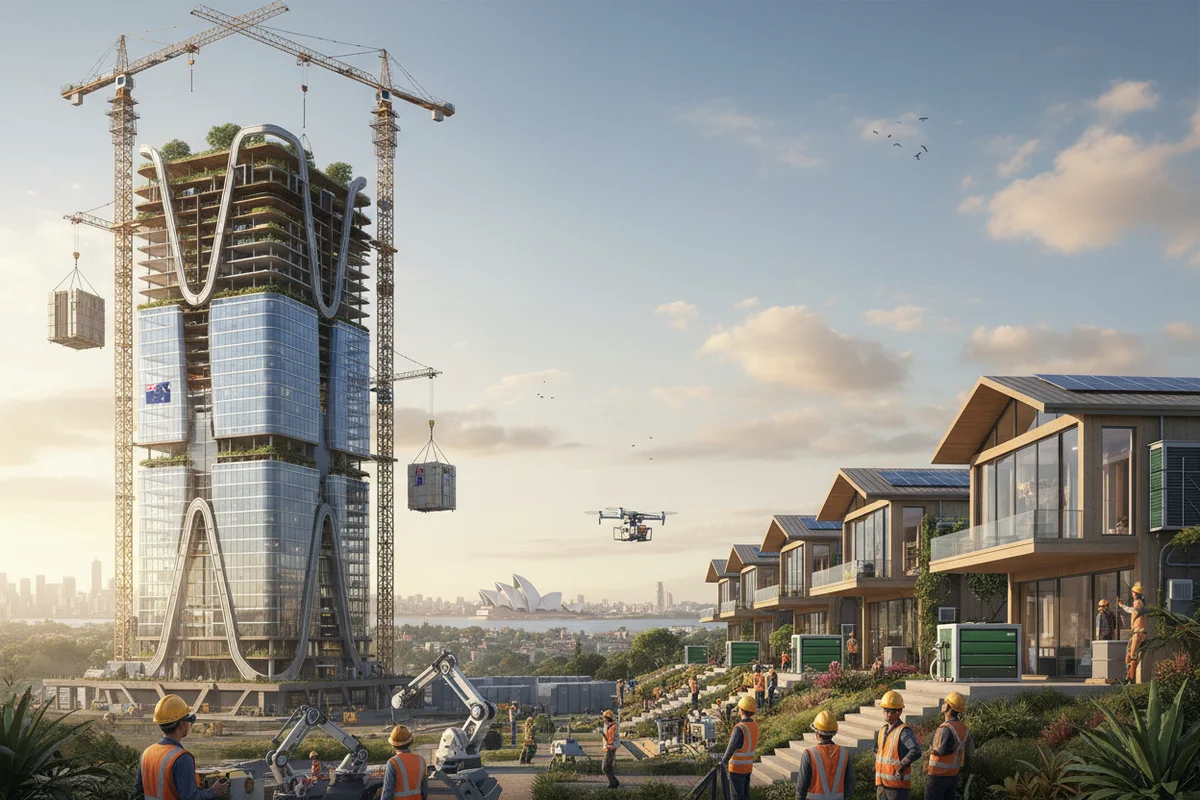
Explore the future of Australian construction in 2025, focusing on costs, sustainability, and the challenges shaping the industry landscape.
Australian Construction in 2025: Costs, Sustainability, and the Challenges Shaping the Industry
Australia's construction industry stands as one of the most significant contributors to the national economy, generating total income of $633.6 billion and accounting for 7.0% of GDP in the 2023-24 financial year according to the Australian Bureau of Statistics. The sector employs approximately 1.3 million people, making it one of the largest employers in the country. For builders, developers, and trade professionals operating in this environment, understanding current cost benchmarks, sustainable building practices, and the structural challenges affecting delivery is essential for planning and executing successful projects in both residential and commercial sectors.
Current Construction Practices
Residential construction in Australia spans a wide spectrum of methods and quality tiers, from volume project homes built using lightweight timber framing to architect-designed custom builds incorporating advanced structural systems and high-specification finishes. Brick veneer remains one of the most common external wall systems in southern states, while lightweight construction using steel framing and cladding is more prevalent in Queensland and northern regions where cyclone ratings and thermal performance requirements differ significantly.
Commercial construction in Australia follows methodologies that vary considerably depending on building type and scale. Office buildings and mixed-use developments in major cities typically use reinforced concrete frames with curtain wall glazing systems, while industrial and warehouse construction relies heavily on pre-engineered steel portal frames that allow large clear spans and rapid assembly. Healthcare facilities demand a higher level of engineering complexity due to infection control requirements, mechanical services density, and the need for structural resilience, which is reflected directly in their cost per square meter.
Cost Analysis: What Builders and Developers Should Expect
All figures below are expressed in Australian dollars (AUD) and sourced from current market data. For international comparison, these figures can be converted to USD at the prevailing exchange rate, which at the time of writing sits at approximately 0.64 USD to 1 AUD.
For residential construction, budget and project homes typically fall in the range of $1,800 to $2,200 per square meter, while standard quality builds come in between $2,200 and $2,800 per square meter. Premium and custom residential construction ranges from $2,800 to $3,500 per square meter or higher, and architect-designed luxury homes can reach between $4,000 and $6,000 per square meter or beyond, depending on the complexity of the design, site conditions, and material selections.
Commercial construction costs reflect the diversity of building types in that sector. Office buildings currently range from $2,500 to $5,500 per square meter, while retail spaces span $1,800 to $4,800 per square meter depending on fitout requirements and location. Industrial and warehouse construction remains the most cost-effective commercial category at $1,300 to $3,800 per square meter, while healthcare facilities attract the highest costs at $3,000 to $6,500 per square meter due to their technical complexity.
Several factors drive variation within these ranges, including geographic location, site access and topography, local council requirements, the availability of trades in a given region, and the specification of mechanical, electrical, and plumbing systems. Projects in remote or regional areas typically attract cost premiums of 20 to 40 percent above metropolitan benchmarks due to logistics and reduced competition among subcontractors.
Sustainable Materials and Energy-Efficient Designs
The Australian construction industry has accelerated its adoption of sustainable materials and energy-efficient design principles over the past several years, driven by a combination of regulatory requirements and growing demand from both commercial tenants and residential buyers. The National Construction Code (NCC) 2022 introduced more stringent energy efficiency provisions for residential buildings, requiring new homes to achieve a minimum 7-star NatHERS (Nationwide House Energy Rating Scheme) rating, up from the previous 6-star standard.
In practice, this has led to greater use of insulated concrete formwork (ICF), structural insulated panels (SIPs), thermally broken window systems, and high-performance bulk insulation products. Builders are also incorporating passive solar design principles more consistently, including correct building orientation, thermal mass, and cross-ventilation strategies that reduce reliance on mechanical heating and cooling.
In the commercial sector, projects targeting Green Star ratings from the Green Building Council of Australia are specifying materials with lower embodied carbon, including recycled steel, low-carbon concrete mixes, and sustainably sourced timber products such as cross-laminated timber (CLT). CLT in particular has gained traction in mid-rise commercial and residential construction as a structurally capable and lower-carbon alternative to conventional concrete and steel framing.
The trade-off is real and worth acknowledging directly. Sustainable materials and energy-efficient systems generally carry higher upfront costs than conventional alternatives, and this premium can range from 5 to 15 percent depending on the specification. However, lifecycle cost analysis typically demonstrates that reduced energy consumption, lower maintenance requirements, and improved asset value over time offset the initial investment for most project types.
Industry Challenges
Labor Shortages
The Hays Construction Industry Report for FY24/25 identifies chronic skilled labor shortages as one of the most pressing constraints on the Australian construction industry. Demand for carpenters, concreters, electricians, plumbers, and project managers consistently outstrips supply in most major markets, contributing to extended project timelines and upward pressure on labor costs. The shortage is partly structural, reflecting an aging workforce and insufficient apprenticeship completions over the past decade, and partly cyclical, driven by the volume of infrastructure and residential work currently in the pipeline.
Regulatory Hurdles
The Property Council of Australia has highlighted that while construction costs have shown signs of stabilization, delivery challenges persist due to the complexity and length of planning and approval processes. Development applications (DAs) in many local government areas can take twelve months or longer to resolve, and the requirements for environmental impact assessments, heritage assessments, and community consultation add further time and cost to project commencement. For developers, this regulatory lag represents a significant risk when financing costs are factored into feasibility calculations.
Material Costs and Supply Chain Pressures
Supply chain disruptions that emerged during the post-pandemic period have eased somewhat, but material costs remain elevated compared to pre-2020 benchmarks. Structural steel, copper wiring, and certain insulation products continue to experience price volatility linked to global commodity markets and shipping costs. Builders working on fixed-price contracts have been particularly exposed to these pressures, and many contractors have moved toward cost-plus or rise-and-fall contract structures to manage this risk more equitably with clients.
Growth Trends and Market Outlook
Despite these challenges, the overall sentiment in the Australian construction market remains cautiously positive. The Royal Institution of Chartered Surveyors (RICS) Construction Sentiment Index (CSI) recorded a reading of positive 9 in Q2 2025, indicating that industry participants broadly expect conditions to improve over the near term. Private residential activity recorded a net balance of positive 12 in Q1 2025, a significant improvement from negative 2 in Q4 2024, suggesting that the residential sector is recovering momentum after a period of subdued activity driven by interest rate uncertainty.
Infrastructure investment continues to underpin commercial and civil construction activity, with major projects in transport, health, and education sectors providing a stable pipeline of work for large contractors and their subcontractor networks. The federal and state governments have committed to substantial housing supply targets, which are expected to sustain residential construction volumes through the latter half of the decade.
Balancing Sustainability with Cost and Delivery
The tension between sustainability ambitions and project economics is one that builders and developers must navigate with care. Green building specifications can add meaningful cost to a project budget, and in a market where feasibility margins are already compressed by land values and financing costs, this creates genuine pressure on decision-making. At the same time, regulatory direction is clearly toward higher environmental standards, and projects that fail to meet emerging benchmarks may face difficulties in attracting institutional tenants or achieving premium sale prices.
The delivery challenge identified by the Property Council is equally important. Stabilizing costs means little if approval timelines and labor constraints prevent projects from reaching practical completion on schedule. Professionals who invest in thorough pre-DA consultation, accurate quantity takeoffs, and realistic program planning are better positioned to manage these variables than those who rely on optimistic assumptions.
Conclusion
Australia's construction industry is a large, complex, and economically vital sector navigating a period of significant transition. Cost benchmarks across residential and commercial categories provide a useful starting point for feasibility analysis, but project-specific variables including location, specification, and regulatory context will always influence final outcomes. The shift toward sustainable materials and energy-efficient design is both a regulatory reality and a market opportunity, even if it introduces upfront cost considerations that require careful management. Labor shortages and approval delays remain the most significant operational risks for builders and developers, and addressing these through workforce development, smarter procurement, and proactive engagement with planning authorities will be critical to delivering on Australia's substantial construction pipeline through 2025 and beyond.