
Navigating Building Codes in Australia: A Practical Guide for Builders and Developers
By draftGecko
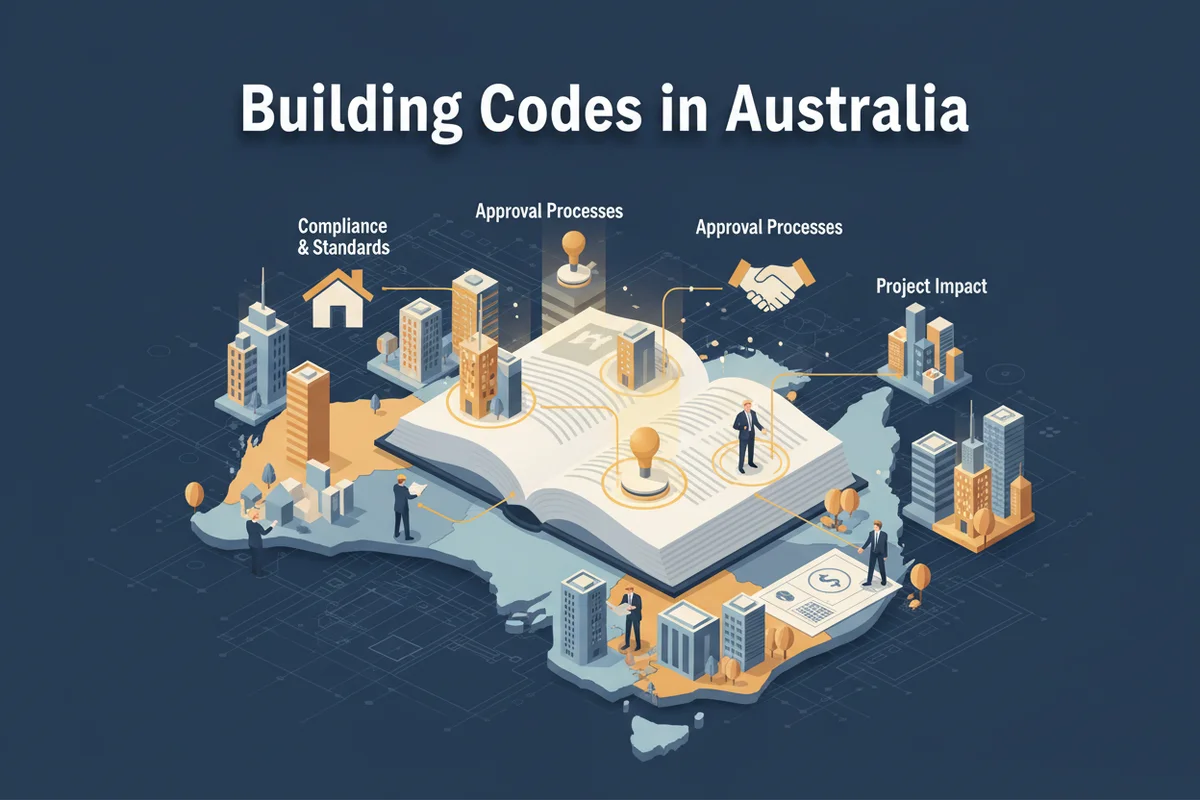
Explore Australia's building codes with this practical guide for builders and developers. Understand compliance, approvals, and project impacts.
Navigating Building Codes in Australia: A Practical Guide for Builders and Developers
Building codes exist to protect the people who occupy and use buildings, and in Australia they form a comprehensive framework that governs everything from structural safety to energy efficiency and accessibility. For builders and developers, understanding this framework is not simply a matter of regulatory compliance — it directly affects project timelines, costs, and the long-term quality of the built environment. This guide breaks down the key components of Australia's building code system, explains how approvals work, and outlines what you can realistically expect when navigating the process.
Understanding the National Construction Code
The National Construction Code (NCC) is Australia's primary set of technical design and construction provisions for buildings. Published by the Australian Building Codes Board (ABCB), it establishes minimum standards across safety, health, amenity, accessibility, and sustainability for new buildings and new building work on existing structures. The NCC applies nationally and is adopted by each state and territory as part of their own building legislation.
The NCC is structured across three volumes, each targeting a different category of building work. Volume One covers multi-residential buildings, commercial premises, industrial facilities, and public assembly buildings such as schools and stadiums. Volume Two applies to smaller-scale residential buildings, including detached houses, townhouses, and small sheds. Volume Three addresses plumbing and drainage systems in both new and existing buildings, setting out the technical requirements for water supply, sanitary plumbing, and stormwater drainage.
One of the defining characteristics of the NCC is that it is a performance-based code rather than a prescriptive one. This means the code sets out the outcomes a building must achieve rather than dictating exactly how those outcomes must be reached. Builders and designers can demonstrate compliance through two main pathways. The first is the Deemed-to-Satisfy (DTS) pathway, which involves following specific construction solutions that are pre-approved as meeting the performance requirements. The second is the Performance Solution pathway, which allows for alternative approaches provided they can be demonstrated to meet the same performance requirements, typically through expert assessment or modelling.
The NCC 2022 edition was adopted by states and territories on 1 May 2023, with certain provisions including updated energy efficiency requirements and livable housing design standards coming into effect on 1 May 2024. New South Wales has indicated it plans to adopt the forthcoming NCC 2025 edition on 1 May 2027, giving the industry additional time to prepare for the changes that edition will introduce.
State and Territory Variations
While the NCC provides a consistent national baseline, individual states and territories are permitted to introduce specific variations and additions to address local conditions, climate zones, and policy priorities. This means that a builder working across multiple jurisdictions cannot simply rely on a single reading of the NCC and assume uniform requirements everywhere.
In practice, these variations can affect requirements for bushfire attack levels (BAL ratings), flood resilience, heritage overlays, and specific energy efficiency targets. Queensland, for example, has climate-specific requirements that differ from those applying in Tasmania or Victoria. Each state and territory building authority publishes guidance on how the NCC is adopted locally, and these documents should be consulted alongside the NCC itself for any project.
Accessing the NCC and Related Resources
The NCC is freely available through the ABCB's dedicated portal at ncc.abcb.gov.au, where registered users can access the full text of all three volumes along with supporting guidance documents and commentary. Registration is free and provides access to the current edition as well as earlier adopted editions.
State and territory building authorities also publish supplementary materials, compliance guides, and worked examples that are particularly useful when applying the Performance Solution pathway. The ABCB additionally provides handbooks and advisory notes on specific topics such as energy efficiency, accessibility, and fire safety, which can assist practitioners in understanding how the performance requirements are intended to be applied in practice.
Development Approval Processes
Before construction can begin on most projects in Australia, some form of development approval is required. The two most common approval pathways are the Development Application (DA) and the Complying Development Certificate (CDC), and the appropriate pathway depends on the nature, scale, and location of the proposed work.
A Development Application is assessed by the relevant local council or, in some cases, a state government panel. The DA process involves submitting detailed plans and supporting documentation for assessment against planning controls, environmental considerations, and community impact. This pathway is used for projects that do not meet the criteria for complying development, including those in sensitive locations, those involving significant departures from standard controls, or those requiring merit-based assessment.
A Complying Development Certificate is a faster, code-based approval pathway available for straightforward projects that meet a defined set of pre-determined criteria. CDCs are assessed and issued by either a council or an accredited private certifier, and they are available for a wide range of residential and commercial work provided the proposal meets all applicable standards without the need for discretionary judgment.
Timelines and Expectations
The time required to obtain approval varies considerably depending on the pathway chosen and the complexity of the proposal. Standard Development Applications typically take between six and twelve weeks to be determined, while more complex applications involving significant planning issues, heritage considerations, or public submissions can take between twelve and twenty-six weeks. Delays are more common when documentation is incomplete at the time of lodgement or when additional information is requested during assessment.
Complying Development Certificates are processed considerably faster, generally within five to fifteen business days when all required documentation is provided and the proposal clearly meets the applicable criteria. This speed advantage makes the CDC pathway attractive for eligible projects, particularly in residential construction where programme certainty is important.
Challenges and Considerations
The performance-based nature of the NCC, while offering genuine flexibility, introduces a degree of complexity that can be challenging for practitioners who are more familiar with prescriptive codes. Demonstrating compliance through a Performance Solution requires rigorous documentation, often involving specialist consultants such as fire engineers or energy assessors, and the outcome of the assessment process is not always predictable. This can add cost and time to projects, particularly where the certifier or building surveyor has a different interpretation of what the performance requirements demand.
The existence of state and territory variations adds a further layer of complexity for developers and builders who operate across jurisdictions. A construction methodology or product specification that satisfies requirements in one state may require modification or additional justification in another, making it important to engage with local regulatory guidance early in the design process rather than assuming national consistency.
Staying Informed and Compliant
Australia's building code framework is well-structured and publicly accessible, but it rewards those who engage with it proactively. Understanding the structure of the NCC, knowing which volume applies to your project type, identifying the relevant state-specific variations, and selecting the appropriate approval pathway at the outset of a project will save significant time and cost compared to discovering compliance gaps later in the process. Keeping track of adoption dates for new NCC editions, such as the planned 2027 adoption of NCC 2025 in New South Wales, also allows businesses to plan ahead and avoid being caught unprepared by changing requirements. For builders and developers who take the time to understand this system, it provides a clear and workable foundation for delivering safe, compliant, and high-quality buildings across Australia.